

Core Abilities to Target That Will Get You Going on the Road Toward Delaying Cognitive Decline and Maybe Even Finding Daily Improvement with Memory/Learning, Attention/Focus, Executive Skills (Planning/Problem Solving/Flexibility/Self-Control)
5 LIFESTYLE PILLARS - Movement | Sleep | Nutrition | Stress Management | Social Engagement
Tool-Bank 1 - The Brain Play Lab
The purpose of this tool bank is to help provide a few key interactive game‑like activities centered on your core domains. The info and elements provided here are intended for purposes of curiosity and habit-building, not diagnosis. Info, items and tools in this section will rotate occasionally between quick games, micro-experiments, and self-tracking kits.
1‑Minute Word Chain (Attention + Flexibility)
Prompt: “Start with any word. In 60 seconds, type as many new words as you can where the last letter of the previous word is the first letter of the next.”
After: show how many they got and a fun note like “You just worked attention, language, and flexibility.”
3‑Object Recall (Working Memory)
Show 3–5 simple images/words for 10–15 seconds (e.g., “apple, key, bicycle”).
Hide them; after a 20–30 second distraction (tiny math or tapping task), ask users to recall.
Position it as “a snack for your working memory,” not a test.
Everyday Problem Puzzle (Executive Skills)
Present a small real‑life scenario (missed bus, budget shortfall, double‑booked schedule).
Ask: “List 3 different ways you could handle this.”
After they type, reflect back: “That’s your brain practicing flexible problem‑solving and planning—core executive functions.”
Tool-Bank 2 - Brain-Friendly Habits Hub
This tool bank provides you a few tools you can choose from to customize your own experiments tied to the Lifestyle Pillars.
DEV NOTE: This tier would be a secondary development effort to build small JS widgets via AI VIBE coding to build out content for this section.
7‑Day Micro‑Move Picker (Movement + Mood)
Let users pick one tiny daily movement (5‑minute walk, 10 squats, stretch after coffee).
Simple checkbox tracker for 7 days with a “How did my brain feel?” slider.
At the end, show a small summary: “You tried movement on X of 7 days—notice any shift in energy or focus?”
Sleep Wind‑Down Builder (Sleep + Stress)
Offer 6–8 options (dim lights, no screens 20 minutes, warm drink, breathing, journaling).
They pick 2–3, create a “Tonight’s Plan,” and optionally rate their next‑day clarity.
Frame it as experimenting with one pillar of brain health.
Connection Bingo (Social + Cognitive)
A simple 3×3 grid: “Text a friend,” “Ask someone a question you’ve never asked,”
“Join a group chat or forum,” etc.Users click when done; when they get a row, you celebrate: “You just checked multiple
social‑connection boxes—another key brain‑health pillar.”
NOTE: We should plan to rotate prompts weekly or regularly so people have a reason to revisit.
Tool-Bank 3 - Brain Journaling & Self-Check-ins Calendar
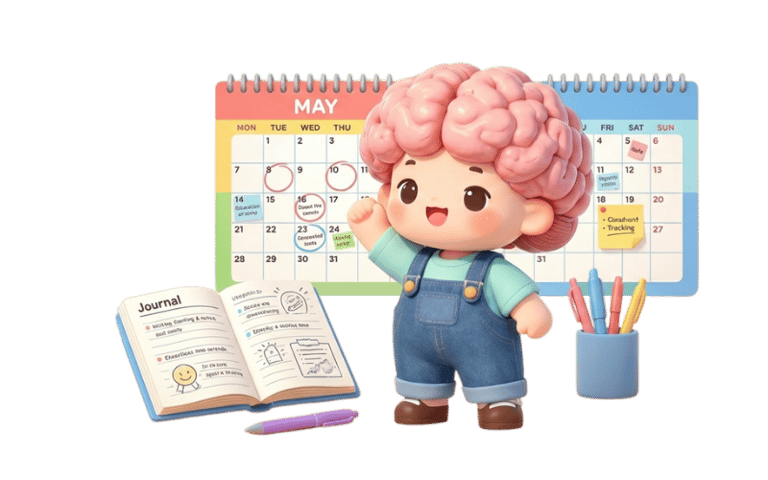
This tool bank helps you with tools and considerations for building out a Self-Check-In Calendar & creating a Brain Journal
DEV NOTE: There is an opportunity here to create some custom JOURNAL type digital files that can be placed on Amazon for visitors to purchase digital on demand publishing-wise. This would be more of a product than directing to some outside source or item for them to aquire?
Today’s Brain Slider
Three sliders: “Clarity,” “Energy,” “Mood” (e.g., 1–10).
One text prompt: “What’s one thing that might be affecting this today? (sleep, stress, food, etc.).”
Over time, you can visualize trends for logged‑in users.
Weekly Wins Log
Prompt users to note 3 small brain‑related wins: “I remembered…”, “I solved…”, “I learned…”.
This reinforces self‑efficacy and keeps the tone positive, which is important for
engagement and emotional health.
Gentle Red‑Flag Reflection
4–5 yes/no questions echoing your “How Is My Brain?” section (e.g., repeated
missed bills, getting lost, repeated questions).If several are “Yes,” show supportive copy: “These patterns are worth paying attention to.
If you’re worried, consider talking with a health professional or using formal tools from
organizations like the Alzheimer’s Association or MoCA.”
NOTE: We should plan to rotate prompts weekly or regularly so people have a reason to revisit.



Site Content Disclaimer: The content provided on We Mind You Thrive (including all articles, videos, and "Bennie's Brain Bites") is for informational and entertainment purposes only. It is not intended to be a substitute for professional medical advice, diagnosis, or treatment. Always seek the advice of your physician or other qualified health provider with any questions you may have regarding a medical condition or mental health concern. Never disregard professional medical advice or delay in seeking it because of something you have read or seen on this website.
Affiliate Disclosure: Some of the links on this website are affiliate links, meaning We Mind You Thrive may earn a commission if you click through and make a purchase. This comes at no additional cost to you and helps support our mission to bring you quality brain-health entertainment and information. We only recommend products and services we believe in.